
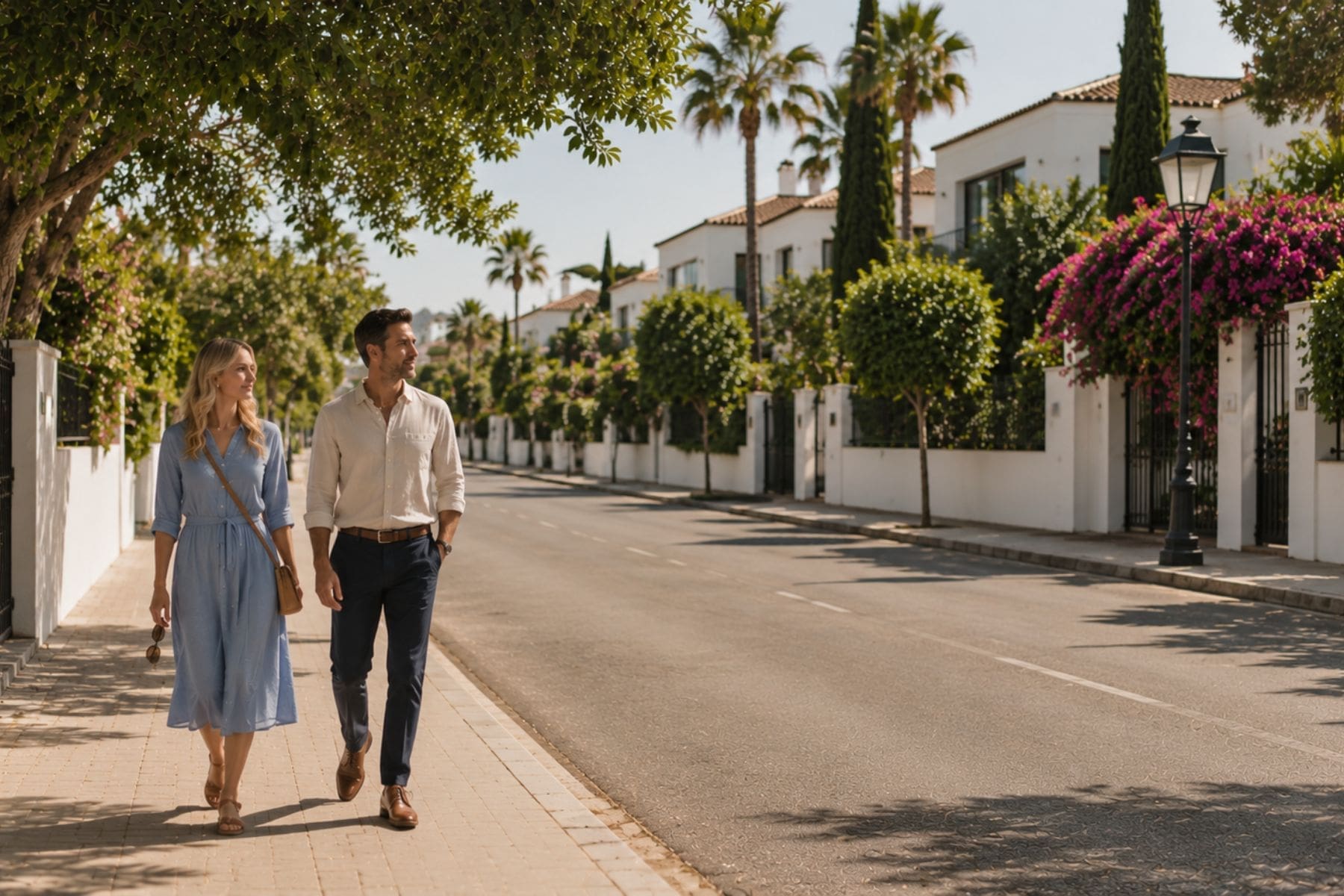
A home can look perfect during a showing.
The patios are well-maintained, the light streams in beautifully, and in the distance you might even see the Mediterranean Sea.
Still, it’s rarely those first impressions that determine whether you’ll enjoy living there later on.
The true quality of a home on the Costa del Sol often lies in things that don’t show up in the photos. The sound when the sliding doors are open. The position of the sun in January. The wind that picks up as it rounds a corner of the building. The slope between your home and the nearest restaurant. Or the vacant lot next to the development where construction might take place in the future.
Anyone viewing a home on the Costa del Sol should therefore look beyond the home itself. You’re not just looking at four walls and a terrace. You’re exploring what your daily life will be like in that place.
1. Traffic noise sounds different with the doors open
On the Costa del Sol, you spend a large part of the year both indoors and outdoors. Windows and patio doors are open more often than in Northern Europe. Noises that are barely noticeable indoors can have a completely different effect on the patio.
This is particularly true for homes near the A-7. Many attractive residential areas close to the beach are not far from this coastal highway. The actual noise pollution depends on the distance, height, intervening buildings, and the location of the patio.
A home may seem quiet when all the doors are closed. So, during the viewing, open the sliding doors and listen quietly for a few minutes.
Don’t just pay attention to through traffic. Noise can also come from:
- an access road to a residential development;
- traffic driving up a steep hill;
- a nearby roundabout;
- deliveries to hotels, restaurants, or stores;
- a garage door beneath the apartment;
- padel courts, swimming pools, or common areas;
- chiringuitos and beach clubs during the high season.
The time of day you visit also makes a difference. A quiet road at 11:00 a.m. can be much busier during the evening rush hour. A beach location that feels quiet in February can have a completely different vibe in July and August.
A brief second visit at a different time of day can sometimes tell you more than a long first tour.
2. Orientation matters more than the amount of light
A south-facing home is often automatically presented as the best choice. In reality, the right orientation depends on how you plan to use the home.
An east-facing patio gets morning sun and can be pleasantly cool in the afternoon. A west-facing patio, on the other hand, gets sun at the end of the day, but can feel intense during hot summer months. A north-facing home can be bright and have an unobstructed view, but generally receives less direct sunlight.
The layout is also a factor. A home may officially face south, but the main living area or the patio that you actually use may face a different direction.
The relevant question, therefore, is not which approach sounds most appealing on paper. The question is which approach fits your rhythm.
Would you like to have breakfast outside in the morning? Do you mainly use the home during the winter? Would you like to enjoy some sun on the patio at the end of the day? Or are you looking for a cool place to relax during the summer months?
The right orientation is a personal choice.
3. A ocean view isn’t the same as winter sun
Once you know which orientation is right for you, there’s still a second question: What does the sun do at this specific location?
A beautiful ocean view doesn’t necessarily mean there will be many hours of direct sunlight on the patio or in the living room.
In the winter, the sun is lower in the sky. Mountains, adjacent buildings, patio walls, and homes located on higher ground can cast much more shade than is visible during a viewing in the spring or summer.
So don’t just ask about the orientation, but also:
- What time does the sun reach the patio in December and January?
- When will she disappear behind the building or the mountain?
- Do the living room and bedrooms get direct sunlight?
- Does the communal pool get sunlight in the winter?
- Are there any overhangs or balconies that block the light?
Photos taken during different seasons can be helpful, but they are no substitute for a careful assessment of the location. If in doubt, a sun analysis can provide a more realistic picture of what to expect throughout the year.
4. Wind conditions can vary from street to street and even from patio to patio
On the Costa del Sol, two winds play a role: the levante from the east and the poniente from the west. How strong you perceive these winds to be varies depending on the section of the coast, the season, and even the street or terrace.
Homes located at higher elevations often benefit from cooler temperatures and expansive views. At the same time, open areas, mountain passes, and spaces between buildings can amplify the wind. Even within a single residential development, one terrace may be sheltered while another is much more exposed to the wind.
Be aware of moving trees and awnings in the area. Check to see if residents have set up glass windbreaks, heavy planters, or other forms of shelter. That doesn’t necessarily mean there’s a problem, but it does say something about the conditions.
Also ask whether the awnings close automatically in strong winds and whether the community imposes any restrictions on permanent windbreaks or other modifications to the patio.
A view is only valuable if you can actually use the outdoor space.
5. A distance of one kilometer can feel very different here
On a map, a supermarket one kilometer away seems close. In reality, that same kilometer might consist of a steep road without a sidewalk, a busy crosswalk, or a route that’s not very appealing in the summer sun.
The steepness of a slope plays a role in determining how independently you can live in a given location. This isn’t just relevant for people with limited mobility. Carrying groceries, taking a walk with young children, or walking to a restaurant in the evening feels different when every route is steep.
So don’t just drive past the facilities. If possible, walk part of the route.
Check the actual walking distance to:
- a supermarket;
- cafés and restaurants;
- the beach or the boardwalk;
- medical facilities;
- schools, if applicable;
- public transportation.
Be sure to think ahead as well. What doesn’t seem like a problem today may feel different if you use the home more often or for longer periods of time.
See also: How do you choose the right neighborhood on the Costa del Sol?
6. An empty lot does not necessarily remain empty
An open piece of land next to a residential development can provide peace and quiet, space, and unobstructed views. But it’s important to know the designated use of that land.
Casual statements such as “they’ll never build there” do not provide sufficient certainty. An unobstructed view is not automatically a protected right in Spain. Whether construction is permitted on adjacent land depends, among other things, on the land-use designation, applicable building codes, any permits, and specific rights that have been legally established.
Therefore, have the following examined:
- what the land use designation is for the site in the PGOU;
- which supplementary or implementing plans apply;
- whether there are any building permits or development plans;
- what building height and building volume are possible;
- where access roads or future infrastructure may be built.
Your attorney can have the planning status verified with the relevant ayuntamiento. That provides more certainty than a verbal promise made during a property viewing.
Also keep an eye out for projects that are already under construction. Temporary construction-related disturbances are different from long-term issues, but they can still affect your first few years in the home, its rentability, and your quality of life.
It’s not just a matter of whether construction will take place. What can be built and where it can be located are also relevant factors.
See also: Why You Need an Independent Attorney When Buying Property in Spain
7. The route to the home is part of the tour
A home may be in a quiet, private location, but it can still be less practical than expected.
Drive the route as if you already lived there. Don’t just start from the sales office—start from the places that are important to your daily life. Think of the beach, the airport, a favorite spot, school, or golf club.
Things to keep in mind along the way:
- heavy traffic at the on- and off-ramps of the A-7 and AP-7;
- narrow or steep access roads;
- lighting in the evening;
- the distance from the home to the entrance of the residential complex;
- parking options for visitors;
- alternative routes when traffic is heavy.
Navigation apps provide a useful guide, but they don’t give the full picture. A 20-minute trip can feel very different outside of rush hour than it does on a weekday morning or during peak season.
You can also compare the different neighborhoods in our Costa del Sol regional guide.
A Practical Checklist for Your Property Viewing
During and after each viewing:
- Open the windows and patio doors and listen to the sounds around you.
- Check the exact orientation of the main living areas.
- Ask specifically about the winter sun.
- Assess wind, shade, and shelter on the patio.
- Walk part of the way to your daily destinations.
- Check out nearby vacant lots and ongoing construction projects.
- Ask your attorney about the PGOU and any construction plans.
- Drive along the main highway at a realistic time of day.
- If possible, visit the area a second time, outside of the scheduled viewing time.
See also: How much does it really cost to buy a home on the Costa del Sol?
Don’t just look at what’s beautiful
During a viewing, a home constantly demands your attention. The kitchen, the view, the bedrooms, and the patio are tangible and immediately visible.
The most important questions often lie outside that framework.
What does the neighborhood sound like? Where does the sun shine in the winter? How do you use this location on a typical Tuesday? Can you spontaneously walk somewhere? What will happen to the vacant lot next door? And does the home suit not only your taste, but also the way you truly want to live?
That’s the difference between an attractive home and a good buy.
First the location, then the home
At MDR Luxury Homes, we don’t start with a list of properties. We start by considering the kind of lifestyle you want to lead on the Costa del Sol.
From there, we look at the right region, the surrounding area, and the day-to-day practical realities. Only then do we assess which home is the right fit. This way, a viewing isn’t just a tour of beautiful interiors, but a careful evaluation of whether a place is truly right for you.
Are you considering buying a home on the Costa del Sol? We’d be happy to help you explore the property and everything that goes with it.


Join The Discussion